
Spain High-Speed Trains: AVE, Avlo, iryo & OUIGO
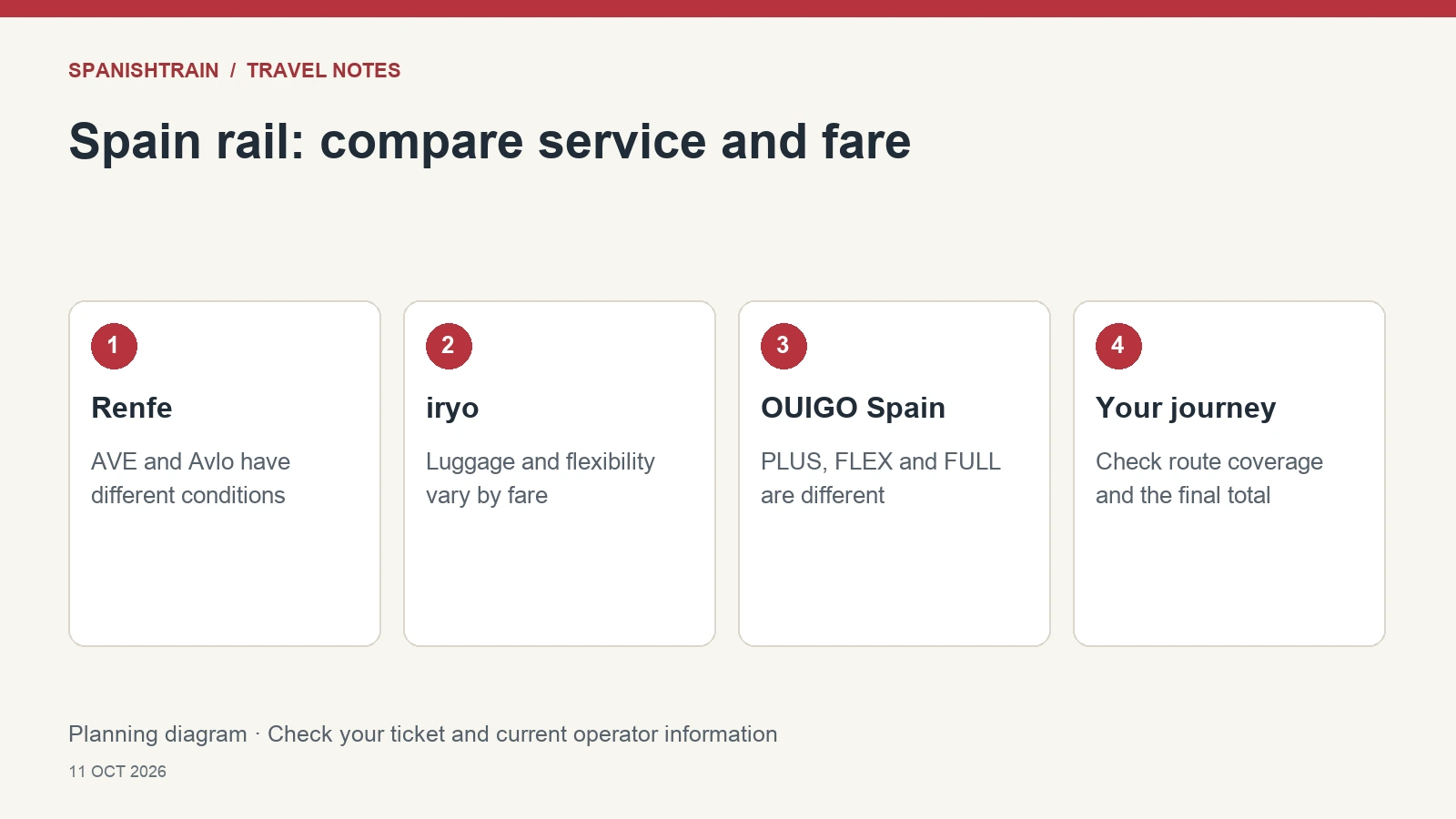
Planning diagram; check the current conditions of your selected ticket.
Spain's high-speed trains are useful for linking major cities, but the service you book matters more than a headline speed. A journey can have intermediate stops, a different Madrid station or a connection that changes its total duration. Use this guide to choose a workable route, understand the operator names and prepare for the station.
AVE tickets, low-cost trains and what “high speed” means
High speed describes a type of service, not a common ticket accepted by every operator. Compare the named product and dated departure. An AVE ticket, an Avlo ticket and a ticket from iryo or OUIGO can have different luggage and servicing rules even when the journeys serve the same city pair. Check the fare rather than inferring its inclusions from the train’s appearance.
For route planning, distinguish a direct train from a non-stop train: a direct service can call at intermediate stations without requiring a change. Also distinguish a reserved seat from choosing a particular seat. Review what your offered fare includes and which extras are selectable through the actual selling channel.
AVE, Avlo, iryo and OUIGO: what the names mean
AVE and Avlo are both Renfe products. AVE offers several fare and seating options. Avlo is Renfe's low-cost product with its own luggage allowance and optional extras. Do not apply AVE conditions to an Avlo ticket just because the operator is the same.
iryo is a separate high-speed operator. Its current fare options include Inicial, Inicial Superior, Espacio Silencio, Infinita and Infinita Bistró. Meal inclusion, luggage and flexibility vary. OUIGO España is another operator; its Esencial, PLUS and FULL packages have different inclusions. OUIGO France's ticket and luggage rules should not be used for a Spanish domestic journey.
Compare the particular offer rather than expecting equivalent “first class” or “business class” products across companies. Our Renfe vs iryo vs OUIGO: Prices, Luggage & Tickets explains the most important luggage and flexibility differences.
Plan around the actual station pair
| Corridor | Stations commonly used | Planning check |
|---|---|---|
| Madrid–Barcelona | Madrid Puerta de Atocha–Almudena Grandes and Barcelona Sants | Compare stops and the duration displayed for the selected departure. |
| Madrid–Seville | Atocha and Sevilla Santa Justa | Check whether the result is direct and whether it stops in Córdoba. |
| Madrid–Málaga | Atocha and Málaga María Zambrano | Confirm the full itinerary and any service notices. |
| Madrid–Valencia | Many services use Chamartín–Clara Campoamor and València Joaquín Sorolla | Verify the Madrid station for the specific operator and train. |
| Madrid–Alicante | Many services use Chamartín–Clara Campoamor and Alicante/Alacant Terminal | Check the named station rather than choosing “Madrid” alone. |
A direct train can stop along the way; it means you do not change trains. A connecting itinerary can involve more than one ticket or even a transfer between Atocha and Chamartín. The operators available and their stops vary by date. This table is an orientation, not a timetable or a guarantee that all products serve every route.
For a Mediterranean journey, see Barcelona to Valencia Train: Tickets, Prices & Euromed: Renfe advertises Euromed there. Do not label every fast intercity service AVE or assume it follows the Madrid high-speed corridors.
Use the timetable instead of a fixed journey-time claim
The departure and arrival times in your dated itinerary are the useful planning figures. A route advertised with a fastest journey time may also have slower services. Track work, stopping patterns and timetable changes can affect durations. Avoid a tight flight or separate-ticket connection based on an old “two-and-a-half-hour” description.
Check Madrid to Barcelona Train: Tickets, Prices & Stations or Madrid to Seville Train: Tickets, Prices & Travel Tips for route-specific booking considerations. Sale-opening dates and prices change; an unavailable date does not, by itself, mean every train is sold out.
Get ready for security and boarding
Check the departure station before leaving your accommodation, then locate the high-speed departures area, security screening and boarding gate. Keep your issued ticket's barcode readable and your matching identity document accessible. Follow station screens and staff directions rather than relying on a platform number copied from another journey.
Plan to arrive with at least 30 minutes available, and add time for large stations or arranged assistance. OUIGO specifically requires passengers in the boarding area 30 minutes before departure and closes access five minutes before. iryo opens boarding 30 minutes before and closes doors two minutes before; Renfe access control also closes two minutes before.
Keep the booking and travel documents separate
SpanishTrain is an independent intermediary operated by WISE UP LIMITED. Its current service supports up to four adults aged 18 or older per booking and does not guarantee every operator or departure is available. Payment leads to manual review and fulfilment, not automatic ticket issuance.
Before travelling, confirm receipt of the official operator e-ticket and verify the passenger, date, stations and selected train. Consult Spain Train Luggage, E-Tickets & Boarding Guide if you need to distinguish a payment confirmation from a valid travel document.
Continue planning your rail journey
Official sources and review
Reviewed on 11 October 2026. The conditions of your selected fare and sales channel apply.
