Spain by Train in 7 Days: Barcelona, Madrid & Seville

Destination illustration: Madrid. This image does not show the departure or arrival station.
For a first seven-day rail trip, three bases leave more room to explore than a new hotel every night. This suggested route runs Barcelona → Madrid → Seville, with six nights: two in each city. It assumes arrival in Barcelona and departure from Seville. It is an editorial itinerary, not a timetable or a package with guaranteed connections.
Budget the two rail legs without assuming a pass is cheaper
For this one-week itinerary, compare the actual Barcelona–Madrid and Madrid–Seville tickets for your dates before choosing any rail pass. If considering a pass, check operator acceptance, required seat reservations and supplements. The route has two planned intercity legs; the number of cities alone does not establish which ticket product costs less.
Keep a separate budget for hotels, local transfers, airport travel and timed attractions. If reversing the trip to Seville–Madrid–Barcelona, check both rail legs again and adapt the arrival and departure days to your flights. Preserve the six-night structure unless you deliberately add another night; an extra city means giving up time somewhere else.
A seven-day plan with two rail journeys
| Day | Suggested plan | Overnight |
|---|---|---|
| 1 | Arrive in Barcelona; keep the first afternoon flexible. | Barcelona |
| 2 | Choose a main sight and a neighbourhood to explore; check admission separately. | Barcelona |
| 3 | Train Barcelona Sants → Madrid; leave time for the hotel transfer. | Madrid |
| 4 | A full Madrid day for museums, parks or the historic centre. | Madrid |
| 5 | Train Madrid → Sevilla Santa Justa; settle in before sightseeing. | Seville |
| 6 | A full Seville day; reserve any timed attraction separately. | Seville |
| 7 | Depart from Seville, allowing for your onward transfer. | None in this plan |
If your return flight leaves Madrid, move the final night there or add another night and rail journey. Do not assume an early train safely connects to any flight. For a southern-focused alternative, choose our Madrid, Córdoba & Seville by Train: 6-Day Itinerary instead of adding more cities to this week.
Turn the plan into dated reservations
Check both long-distance legs before booking accommodation. Barcelona services commonly arrive at Madrid Atocha, and Seville services commonly leave from Atocha, but verify each ticket's full station name. Use the displayed arrival and departure times; no fixed “under three hours” claim applies to every service.
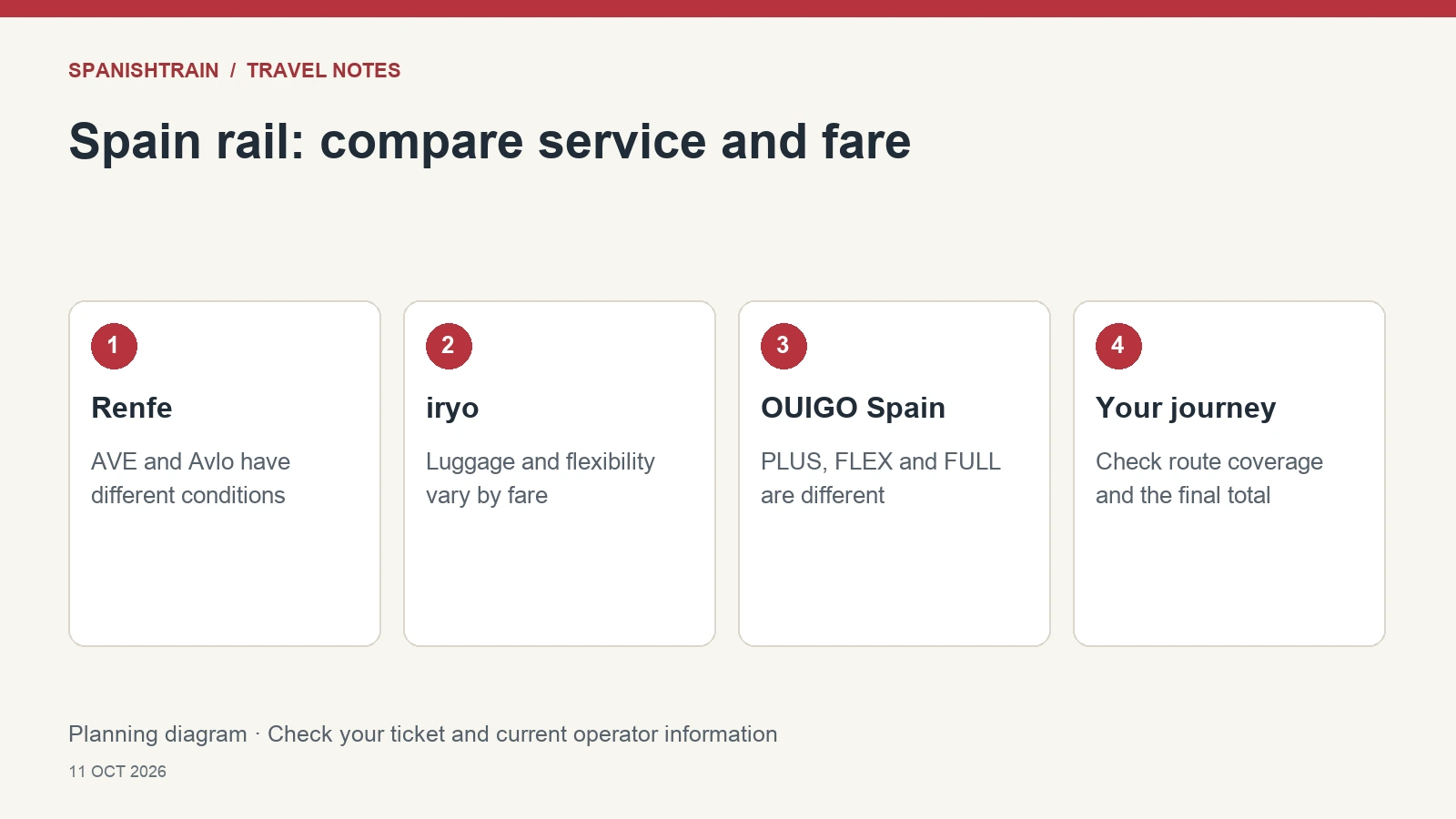
Compare the complete fare, baggage allowance and change conditions. Sale-opening dates vary, and booking a fixed number of weeks ahead does not guarantee the cheapest price. Read the Renfe vs iryo vs OUIGO: Prices, Luggage & Tickets before choosing a restrictive fare.
Plan stops, luggage and transfers
A ticket for one train is not a hop-on, hop-off pass. If you want several hours in an intermediate city, book appropriate separate legs or an explicitly supported stopover itinerary. Ordinary station stops do not allow sightseeing followed by boarding a later train.
Confirm hotel bag storage or a luggage-storage provider before relying on it; station lockers, opening hours and capacity are not guaranteed. Check the local bus, metro or taxi journey to each hotel. For separate-ticket connections, assess the transfer and missed-connection conditions rather than assuming automatic protection.
Booking through SpanishTrain
SpanishTrain is an independent intermediary operated by WISE UP LIMITED. Current bookings accept up to four adults aged 18 or older. Available results do not guarantee all operators or departures. Payment is followed by manual review and fulfilment; travel only after receiving and checking the official operator e-ticket.
Continue planning your rail journey
- Madrid to Barcelona Train: Tickets, Prices & Stations
- Madrid to Seville Train: Tickets, Prices & Travel Tips
- Spain Train Luggage, E-Tickets & Boarding Guide
Sources and review date
Reviewed on 11 October 2026. Official sources support the routes; the day-by-day allocation is an editorial suggestion.